The Holiday of Memory

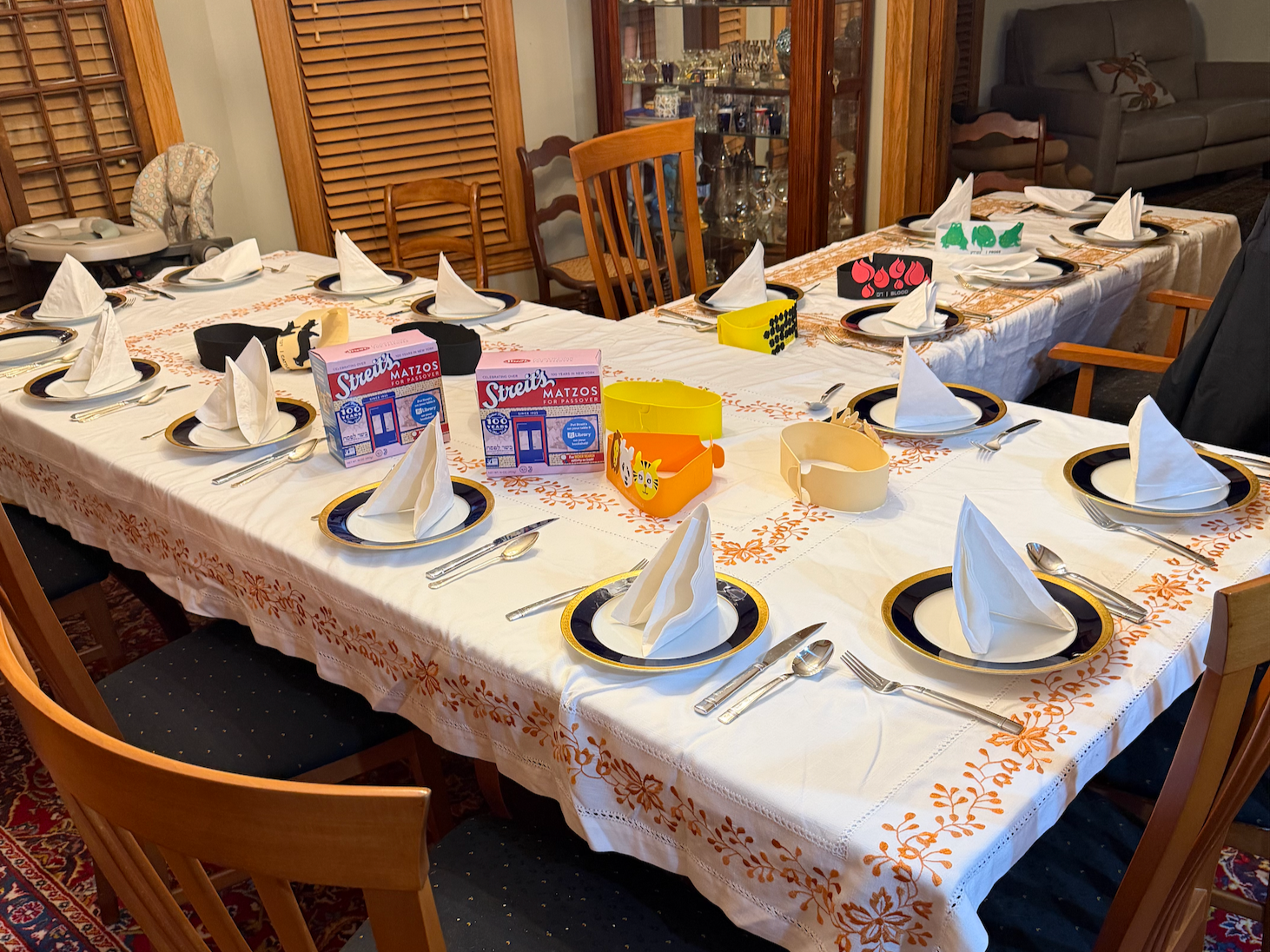
…the first table setting the day before the Seder..more plates were added

It’s really only eight days, but preparing for a Friday night with challah again feels like a big deal now that Passover has concluded. 

Now that the extensive preparation and planning are over, I have time to reflect on this annual experiential holiday that requires us to relive the story of the Exodus from Egypt. It’s the story of the Hebrew people, originally welcomed by Egypt’s rulers as sages, who then were seen as “other” by a new king who had not known Joseph or his brothers. Not that biblical timelines are perfect, but it apparently took about 100 years - a couple generations - for the helpful to become an enslaved people.

And every year - now some 3,000 years later - we gather around tables with family, friends, and always the children to retell, and relive, the story of the exodus. 

All families have different ways to bring the story alive so that we can experience the pain of slavery - with vibrantly bitter horseradish in this house - the tears of our ancestors, with radishes dipped in salt water - with various mideastern haroset, or sticky dried fruit, nut, red wine pastes that remind us of the mortar used to build the Pharaoh's temples. 

The ten plaques take on lively dimensions when ping pong balls fly across the table as the plague of hail is called, or bouncy plastic frogs, or dark glasses, or wild animals. And depending on the attention span of the children, there are sticker books to occupy little fingers as we tell the story one more time.

Passover is all about memory - ensuring the story of becoming an “other”, of suffering slavery and our ancestors' quest for freedom and autonomy through the hand of God - remains real for Jews today and for our children and grandchildren. 
It’s also a holiday where we remember all those who have shared our table over the years. 

Even when patience is waning, I need to sing Dayenu to bring back the memory of my mother-in-law's laughter as she sang that tune with great gusto. We remember Uncles Harry and Abram who liked to argue the timing of sundown in this Northern state, from their equatorial perspective of time. One of them loved watching us burn the hametz in the tin pail, while the other was bemused at our feather and wooden spoon search with the kids before the start of the holiday. 

And this year, others emerged at our table. The mother of a dear friend who departed a few months ago, meaning it was the first time he was observing without her in his 70+ years. My college roommate, who would have loved sharing the measured chaos of a Seder with her grandchildren if she’d had the gift of time to do so. Our former neighbor, who was always so curious about Jewish holidays. 

Once more, we put away the matzo platter, sweep up the crumbs and reintroduce pasta and bread and cakes to our menu, and hope the memories we created this year will last.

Is it ADHD...or...

….even Hank and Herbie can’t decide what to do next…

It’s been coming on in the past eighteen months or so, this feeling that someone missed my ADHD diagnosis. My doctor friends tell me that I would have needed an ADHD diagnosis by the time I was 12 for this to be my true issue. But in the 1960s, we really didn’t know that much about the causes of squiggly kids who couldn’t pay attention. 

My symptoms now have all the signs - an inability to focus on one thing longer than a few minutes; distractions that occur with an increasingly random frequency; a pile of books I really, really want to read that’s gathering dust; phone conversations that trail off midway through a sentence; walking into rooms with a purpose that flies away the minute I cross a threshold. 

All of these make planning for tomorrow or even later today a real chore. 

So if it’s not ADHD, what could it be?

It could be age. I’ve heard that people at “our age” tend to wander a bit. We do have decades of experience to mentally leaf through whenever we confront the latest life experience. That can be distracting.

It could be the wide array of inputs that ping and ding and flash on any screen I’m wearing, holding, or staring at in the moment. As a kid, my inputs were limited to one newspaper, one TV, a transistor radio, and that lady down the street that knew everything about everyone. 

It could be the experienced chaos of life in Minneapolis over the past year with assassinations of a legislative leader and her husband, shootings at a Catholic school sanctuary, and roaming ICE thugs pulling brown, black, and Asian neighbors from our streets. And yes, Tom, it truly was that random. The fact checking and documentation now showing up in courts is overwhelming.

It could be the widening recognition that there is little reason to have any confidence in the competence of those “in charge” of federal or national institutions that have stood fast for 250 years in this experimental democracy of ours.

It could involve what’s happening on the other side of this fragile globe as this country appears to be marching towards full out war in the Middle East. And it’s truly a struggle to track all of the reasons why we are there now. 

Or maybe, maybe it’s just the weather. We had a blizzard on Sunday, then it was 77 degrees the next Saturday, then it bounced back to 29 degrees by Monday. Spring does bring out the most chaotic changes, doesn’t it? 

Building and Nurturing Resilience

This is a picture of my friend Carmela standing on the frozen Lake of the Isles during last weekend’s luminary loppet event, the lights of downtown Minneapolis in the distance. 

As in years past, thousands of Minnesotans flocked to this event both to help light the candles, bonfires, and displays that make this a favorite event of winter on the ice - and to participate in its glorious effect. 

This is what Minnesotans do in the midst of snowy, icy winter in one of the coldest states in the nation. We bundle up. We go outside. And we revel in the beauty of lights in the midst of dark, seeking warmth on frozen lakes, and the community of neighbors who share our commitment to protecting what we’ve built. 

This is how we nurture our resilience that has been sorely tested with the siege of our cities and state. 

As individual stories come out of the grotesque grabbing of kids on the way to school and of parents out to buy groceries, our resilience can crack and threaten to break. But it hasn’t yet. 

Instead, nearly all of us find ways to help out and every act of support builds resilience. Many truly nurture our collective resilience. 

Such as witnessing nearly 2,000 men and women meet at a downtown church to march together as part of a Singing Resistance group that totals more than 5,000 souls so far. They march through downtown streets singing hymns and songs of support for our neighbors too afraid to leave their homes. That is nurturing to all involved.

Thousands are buying groceries and supplies as part of a vast array of networks providing mutual aid to those who need help. Churches, community centers, restaurants that are understaffed but working long hours, and neighborhood blocks are all actively involved. 

And that is nurturing to the battered soul of our city and state. 

Some are raising funds for those they know who can not leave their homes. Money for rent and for utilities to keep homes warm while they shelter inside. Money for iPads for kids who are “going” to school virtually now. That is building resilience. 

At this point, it’s clear to those of us who live here that our built and inherited resolve will sustain us. And we will persist in calling attention to violations of civil and criminal law as they occur. Because that is nurturing for our Constitutional democracy. 

Despite news of a “draw down”, 2,300 masked and armed men continue to roam our streets and cruise around schools, day care centers, and hospital parking lots. Nursing homes are struggling to remain open as so many caregivers are immigrants who are too afraid to go to work. 

Even if all the excessive ICE force leave soon, the traumatic impact of this siege on our city and state will be remembered for generations. And we will remain resilient. We will survive.

Minnesota Resolve

Scenes from the annual Art Sled Rally in Powderhorn Park this week…flourishing creativity in Minneapolis.

We are not native Minnesotans as we’ve only lived here 35 years or so. And yet, we have learned a few things about the people who call this North Coast state “home”. 

We’re somewhat tough and gritty with a big base of Scandinavians and Germans. We relish all four seasons and when temperatures move from single to double digits, we find it downright balmy and time for outdoor sports. 

When we arrived in 1990, the population was 94% white and today it’s 77.5% white. Still mostly pale people up here. And thank heavens for the immigrants. The turkey and meat producers, large dairies, Hormel all are fueled by the new arrivals to Minnesota. 

And that shift has been incredibly important for our culinary scene. When we first arrived, there were steak houses and Perkins. Today, we have world class Asian, Indian, Hmong, Somali, and Spanish restaurants. After all, who wouldn’t prefer fish tacos to lutefisk? 

What is still solidly in place are the core values of this state - a strong belief in hard work, a dedication to fairness and kindness, and a strong sense of community. We’re proud of our cultural institutions and icons - our theaters and music scene, our world class art museums - and Dylan and Prince. 

What we’re experiencing right now - at the end of the second week of the Siege of Minneapolis - is a deep resolve taking hold. Neighborhoods are setting up Signal groups. We’re delivering food to neighbors afraid to leave their homes. We’re gathering around restaurants and day care centers to provide cover for workers to safely enter their jobs. We’re providing rides home for those with any melanin in their skin who are afraid to drive right now. 

And yes - we’re protesting the outrageous behaviors of ICE in as many creative ways as we can. There are singalongs with band instruments. Artists are getting engaged, and there are puppets and kites. And yes, people who gather are getting tear gassed simply for being there, which leads to scuffles and shoving - and that only builds more resolve. 

Pay attention to what’s happening here - as this administration’s antipathy to this state won’t stay focused for long. Remember - this is a big brutal distraction from massive malfeasance taking place within institutions we used to rely on - financial, regulatory, and judicial…not to mention the Epstein Files…

Minneapolis Under Siege

Image from this morning’s MN Star Tribune…

We woke up this morning to a city that is holding its breath. 

We’ve been here before and have become practiced at pulling in, watching carefully, responding with strength and resilience while holding on to the certain knowledge that we’re in the midst of another new level of insanity in this community we call home. 

This time is different. It’s not just a few bad actors with guns who violated their oath to serve and protect, and then lied about what had taken place when a man died, literally, under their knee. At that time - a brave young teenager provided the video proof that what was initially reported - “died of a heart attack” - was much different than the evidence of a 9 minute choking knee on the neck.

Today it’s roving gangs of thugs dressed up in masks and jackets carrying large artillery and lethal weapons grabbing anyone on the streets who doesn’t look like “us”. That may sound judgemental - and it is.

When cars turn up at community day care centers early in the morning to grab anyone entering or dropping off who is speaking Spanish - no questions, no warrants, just grabbing - then yes, that’s thuggery.

When large groups of ICE show up outside public schools as parents are picking up their kids, then bash in windows when a woman refuses to open her car door before being hauled out and taken, leaving a car running near the school, that’s thuggery. 

And when an ICE agent shoots through a car window at a car driving away,...well, the multiple videos produced by observant citizens will provide the proof that this agent was at no risk regardless of those trying to spin the story they want you to believe. 37-year-old Renee Nicole Good is dead because of thuggery. 

On Monday, Kristi Noem was posing for cameras in the Twin Cities - proudly talking about taking hardened criminals off the streets. Hardened criminals working at day care centers who are credentialed to care for babies? Hardened criminals driving their kids to school being ripped from cars? 

No warrants, no questions asked - just snatching people, taking them to “detention” in unknown locations, many to be released hours later when it is shown that indeed they are U.S. citizens going about their daily lives. 

This isn’t a rational response to a true threat to this country, is it? This is about causing chaos, terrorizing anyone who speaks languages beyond English, who has melanin in their skin, or who has fewer resources to fight back. 

So today, Minneapolis public schools are closed to reduce the numbers of “soft targets” for the ICE thugs. And people appear to be staying home as well. 

The community trauma is real. The fury, the fear, the outrage, the sadness - all of this is real right now. 

I’m both outraged and embarrassed that this is my country today. When did our nation’s values and mores fall so far that we would support the weaponization of bully culture targeted at daycare centers for our nation’s babies? How can any of us stand by as this type of actual evil is taking place in our neighborhoods?

I recognize the importance for our community to avoid reacting with the full righteous indignation this situation seems to call for. A truly righteous response would invite more military presence and a call for martial law in Minnesota. Who knows? We might even incite a “Venezuela” response from this administration with paratroopers dropping in to remove elected officials.

For now? We’re telling our friends and family to stay vigilant. Write to every person in elected office who is charged with representing you to let them know - “this isn’t the country we know any more, so stand up, speak up, and tell this administration to follow the constitution with its entire bill of rights.” And above all - be careful out there.

Always Remember...

Our Koppel Family Heritage Tour in Sopron, Hungary in 2009 with our recently departed Aunt Vera in sun glasses behind the Koppel monument…standing next to our other Aunt Vera in hat and white t-shirt.

Every now and again I see a movie that stays with me, making its point long after the lights come up. One that grounds me in today’s “now” with a whole new perspective.

The soon-be-released film, Nuremberg, is one of those movies. 

This week, I saw a premiere of that powerful and important new film. It’s based on a book written by local friend, Jack El Hai. His book, The Nazi and the Psychiatrist, focuses on the interactions of Hermann Goring and psychiatrist Douglas Kelley, hired by the US military to determine whether members of the former Nazi high command were fit to stand trial. 

Not an easy film to watch - but a compelling reminder of a history we don’t want to forget or repeat. 

The film reminds us that prior to that post WWII trial, there had never been an international court established to bring the leaders of any country to account for crimes against humanity. That military tribunal made up of the four Allied powers (U.S., French, British, and Soviet Union) established a framework for holding the leaders of aggressor countries accountable for the havoc wreaked on innocent families and communities. 

Russell Crowe plays a bone-chilling Goring and Rami Malek is the psychiatrist Kelley, whose relationship to his “patients” was frequently blurred between professional and personal. 

The timing of this film is powerful personally as well. 

Our family recently lost the last of our relatives who survived the Second World War in Europe with the death of Aunt Vera earlier this month. 

Vera was our particularly spunky Aunt, who survived the war in Hungary, then escaped with her mother during the brief 1956 Hungarian Uprising against the strictures of Soviet Union rule.  

Vera was the youngest of the Koppel aunts, the bonus matriarchy I inherited when I married Jacques. She was married to Uncle Andre, the youngest of the five surviving Koppel siblings. Uncle Andre survived Auschwitz with many of the well-documented physical and mental health issues of survivors. And he was always kind and wonderful to us. 

Before the war, there were ten Koppel children of that generation. Two got out of Europe before they were taken to concentration camps and three survived the camps.  The Koppel men all married - or remarried - after the war. Uncle Konchi lost his family in the camps, but met and married Aunt Fifi in the displaced persons camps. Uncle Rudy married our other Aunt Vera and immigrated to Canada. Uncle Alex married Aunt Pearl, the only American of the group. There was Aunt Helen, Aunt Greta, and Aunt Mimi, who was Oskar Schindler’s actual secretary who produced the famous list. 

Vera was the first of the Koppel Aunt matriarchy that I met nearly forty-five years ago. I never had to wonder what Aunt Vera thought about anything - she told me whatever was on her mind whenever we got together. That’s one of the many things I loved about her. 

Her strong opinions were balanced by an open mind and deep caring for her family. She would listen to a good argument, think a bit, and could change her mind. 

I traveled to Hungary with Vera and Andre two times. The first was in the early 1980s, when Andre wanted to return to his home place in Sopron with his son Robert. We were invited to join them, but Jacques was just starting a new position and unable to go. So I went. 

As someone born and raised in Ohio, I was surprised with Vera’s caution about candid conversations inside hotel rooms. She was convinced that the secret police had bugs in place and would arrest her for having escaped thirty years earlier. I didn’t understand the depth of that fear then. I do now. 

By the time we returned in 2009 for the well planned Koppel Family Heritage Tour, organized by Vera and her granddaughter Rebecca, some of those fears had abated. She led a group of 21 Koppels - nieces, nephews, great nieces and nephews, and cousins - to Budapest and Sopron where we saw the remains of thriving Jewish communities that were no more. And learned the human stories of what had been. 

Nuremberg, the film, brought back so many memories from that trip - of the relatives that survived and those who didn’t. And of our fun and feisty Aunt Vera who was the last of the survivors in our family. 

See the movie that opens November 7th. The final line, delivered by the U.S. prosecutor is prescient - “We are able to do away with domestic tyranny only when we make all men answerable to the law…so that it can never happen again.” 
This is a good time to remember what humans are capable of becoming when any one man is worshipped above all others or above the rule of law designed to contain the worst of human tendencies.  

Becoming An Ancestor...

Photo of my ancestors - Grandfather Alleshouse in upper left of last row, next to Great Uncle Sam Schauweker, and my Great Grandmother Lucinda.

As I was picking at some gunk in the bottom of the slow cooker, it hit me - I’m just like my mom - the woman obsessed over the ditzely details of cleaning the kitchen while forgetting to turn on or off the oven for the casserole. 

It can be startling to recognize one's mother in the mannerisms of one’s self. Particularly those that are clearly the result of nurture versus nature.

It’s something I’ve been thinking a lot about since last week when our Rabbi launched the Days of Awe with a sermon on becoming an ancestor that elicits good memories. This is the period of days when we are to reflect on our behaviors over the year past, repent for harm or hurts we’ve caused, and remember our ancestors and their impact on our lives. 

I consider myself  lucky with the array of ancestors I can count. My father’s family arrived in this country in the late 1700s, with my Great-Great-Great Grandfather Frederick appearing in the first U.S. Census of 1790 in Pennsylvania. His son Ludwig, or Lewis, moved his family to the frontier of Ohio in 1818. 

This family history was all meticulously documented by my Uncle Paul, Dad’s youngest brother. It was his wife - Aunt Marge - who provided the critical nudge for him to compile a remarkably rich history of our family in this country. Thanks to Uncle Paul, we have tales of the reputation of our Great Great Grandmother Mary Conrad and her colorful personality featuring clay pipes smoked in the garden. 

I know my Alleshouse ancestors as “gentlemen farmers”, engaged with their church community, musically gifted, with creative arts talents we inherited in the form of beautiful quilts stitched by my grandmother. I knew my grandfather as a quiet, thoughtful soul who had a way with bees, resulting in luscious honeycombs of honey on his dining room table. 

I know less about my Blue ancestors - other than they had family above and below the Mason-Dixon line during the Civil War, making for awkward family reunions for the next hundred years. 

Harvesting a red tomato in Minneapolis today takes me back 60 plus years to Grandma’s large garden behind her house in Deshler, Ohio, as she handed me one of her prize picks with a gentle, “Try this, Mary Margaret”. I’ll chase the flavor of those warm fresh tomatoes as long as I live. 

My birth family also landed in this nation as it was being born, ending up in Eastern Tennessee. My new-found family tells stories of Grandpa Arnold’s talents making moonshine as a way to pay the taxes on their extensive properties, before tragedy took Grandma. That led him to the mountains of West Virginia where he could earn enough to feed his five children in the coal mines. 

Apparently my birth mother wasn’t interested in remaining in Welch, as she hightailed it to Columbus, Ohio when she learned she was pregnant. There she gave birth to me, her only child, promptly found a job, got an education, married, and never told a soul of my existence. 

I certainly don’t blame her for that, as the 1950s were a rather punitive period for unwed mothers. 

My parents, on the other hand, were thrilled to finally have their baby after years of trying. I went home from the hospital, lying on a blanket in the backseat of my parents’ car with my father driving so slowly that my mother remarked on it to the day she died. 

All of this leads to the challenge our Rabbi posed in his sermon. What kind of ancestor do we want to be to those who come after us? How will we be remembered? 

I have a few more days until Yom Kippur closes out, and the allegorical Book of Life is slammed shut for the year. So as the pace of current events swirl around us at dizzying speeds, I find myself wanting to pick at small drippings on the inner base of the slow cooker while I ponder the stories I hope to leave with our children and their children.